01
Thresh does the first pass. You make the call.
Nothing goes live on its own. Read the draft, change what you'd say differently, and publish when it's right.
Your best customers already figured this out.
A customer on their third bottle knows things a first-time buyer doesn't — how it layers, how long a bottle lasts, who it isn't for. Thresh FAQ sorts through your reviews, finds the themes that keep coming up, and drafts the FAQs in minutes, written cautiously about claims, so your time goes on checking, not writing.
Your first 3 runs are free · No credit card · No subscription
Every FAQ starts from something a customer already told you — a question they raised, a hesitation they named, a detail worth passing on. Thresh drafts it quickly and carefully; you make the final call.
Nothing goes live on its own. Read the draft, change what you'd say differently, and publish when it's right.
In skincare, describing a product and making a treatment claim are only a few words apart, and general-purpose AI writers can slip into lines like "clears acne" or "repairs your barrier." Thresh is written to stay on the describing side — texture, layering, how long a bottle lasts, who it suits — so there's less to rewrite. It's a careful draft, not a compliance check: you still read every line.
Reading every review, spotting what keeps coming up and drafting answers is the job that never gets done. Thresh reads up to 200 reviews per product and drafts the set in one step, in a few minutes. It also shows you what keeps coming up, with a review count for each. No analyst, copywriter or marketer needed.
A description says what a product is. Reviews establish what it's like: how it absorbs, how it layers, how long a bottle actually lasts, how it behaves under makeup. That's the material a shopper is looking for and the material a product page usually doesn't have.
Thresh reads only the review text you hand it, and writes nothing back anywhere. You add a product, upload a CSV or paste your reviews, and get a real set back — your storefront, your catalog and your customer data stay exactly where they are.
One of our test products came with a description full of treatment claims — "medical-grade treatment for eczema", "clinically proven to repair the skin barrier" — and reviews like "my hands stopped splitting open at the knuckles." Here's what Thresh drafted when shoppers asked about it.
Thresh's first draft, unedited
Will this actually help with cracked, splitting skin?
The balm is formulated with a ceramide complex, shea butter and squalane in a petrolatum base, designed to sit on rough, cracked areas as part of a twice-daily routine. How noticeable any change feels depends on the severity of the skin and how consistently it's applied; this is a cosmetic balm, not a treatment for eczema or dermatitis, so if you're managing a diagnosed condition it's worth checking with your dermatologist on where it fits.
From a test run on a sample product, on an earlier version of Thresh. Thresh kept the useful detail and left the treatment claims out. It's still a draft: check it against your own product before you publish. More on this: how to write product page FAQs for skincare without making drug claims.
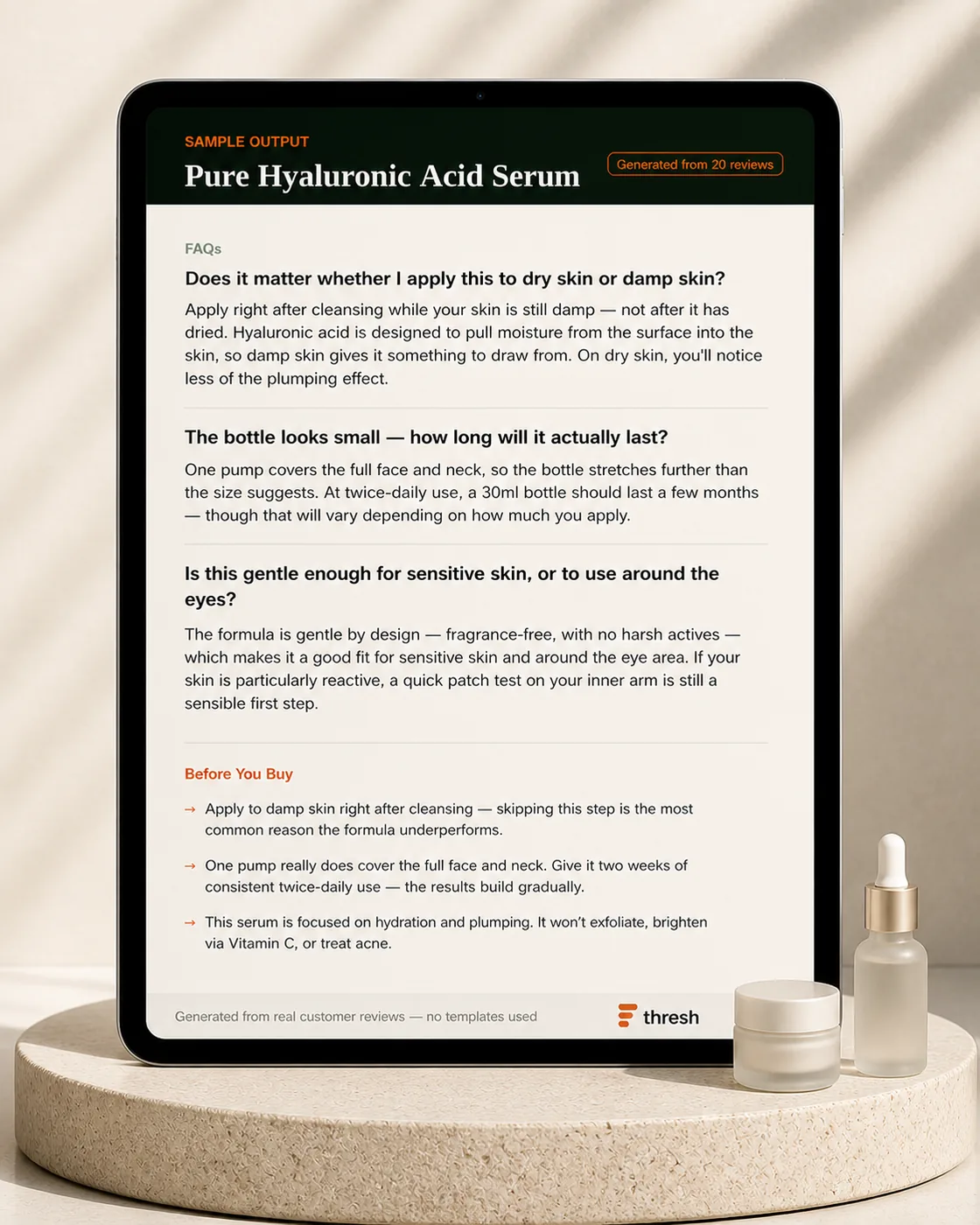
Every FAQ set comes with before-you-buy notes: the short, practical things experienced customers know. Apply it to damp skin. A little goes further than you'd think. If your skin reacts easily, patch test first. Sometimes that includes who a product isn't the right fit for — which is exactly what a regular would tell a friend.
A shopper who arrives knowing it's fragrance-free but won't clear active acne isn't the shopper who buys it expecting acne results.
Nothing goes live until you decide. You read every draft, change what you'd say differently, and copy it out yourself.
One path, and it takes about a minute — name the product, describe it, bring the reviews.
Your reviews stay yours. Thresh reads them to write the FAQs and writes nothing back anywhere.
One click. Thresh FAQ reads your reviews and drafts up to 10 FAQs on the questions your customers raised, plus before-you-buy notes, written cautiously about claims.
Under the notes, Thresh FAQ lists the recurring themes and how many reviews mention each. A review is an answer to a question nobody wrote down.
Read the draft and edit anything you'd say differently — you know your product, your ingredients and your market best. Then copy the set and paste it where shoppers will see it.
There's no tier to choose and no plan to compare — every account gets the same one. A run is one FAQ set for one product.
That's the entire price list. Your first three runs are on us, and every run after is $2.45 — the same product, whenever you happen to need it.
No credit card required.
One run generates one FAQ set for one product. We count runs, not products — regenerating a product is a new run. You'll see it in the app before it costs anything: "You've used your 3 free FAQ runs — this run will be charged at $2.45."
The things merchants ask us first.
Thresh FAQ is a web app for skincare brands. It reads a product's customer reviews, finds the questions and details that keep coming up, and drafts product-page FAQs and before-you-buy notes for you to review and publish. Reviews go in by CSV upload or paste, and it never connects to your store. The first 3 runs are free, then $2.45 a run.
Treat them as a careful first draft. Thresh sticks to what your reviews and product description support and steers away from treatment-style claims, but AI can make mistakes, and you know your product and the rules for your market best. Read every answer, edit what you'd say differently, then publish.
No tool can promise that, and Thresh doesn't. It's written to lean cautious — describing what a product is and what using it is like rather than what it treats — so there's usually less to rewrite. It isn't legal or regulatory review; if you're unsure about a claim, check with a qualified professional.
You can get close with a general AI chat and a careful prompt. Thresh saves you building and checking that prompt every time: it reads up to 200 reviews per product, drafts answers with claim caution built in, and lists the themes that keep coming up, the same way on every run.
Any platform you can get your reviews out of. Thresh works from your review text and never connects to your store, so it makes no difference whether you sell on Shopify or anywhere else — if you can export your reviews to a CSV or copy them, Thresh can use them. If you sell the same product on more than one channel, combine those reviews into a single upload and the FAQs are written from all of them.
There's no connection to make. Thresh never asks for an access token and never touches your store — handing a third party live store access is a real risk to take on for a tool that only needs to read some review text, so we don't ask for it.
Two ways, both inside the app. Upload a CSV of your reviews — the only column we need is review_text — or paste them straight in, one per paragraph or numbered Review 1:, Review 2:. Up to 200 reviews per product.
You'll see what was found — "12 reviews found, 2 skipped" — before anything is saved.
One run is one FAQ set for one product. Your first three runs are free — that's three per account, not three a month — and after that each run is $2.45. There's no subscription.
We count runs, not products, so regenerating a product you've already done is a new run. A run that fails doesn't count against you, and the app tells you before a run is ever charged. If the theme list can't be built for a run, you still get your FAQs and before-you-buy notes, and the run counts.
Around ten or more is where it gets good — that's usually enough for the same concerns to come up more than once, which is exactly what Thresh is looking for.
Below that it still works, but it leans more on your product description to fill the gaps. So check any product fact in the answers against your own description.
No. Nothing is written to your storefront and nothing goes live on its own. You read the drafts, edit what you'd say differently, then copy the finished set and paste it wherever you want it — product page, help centre, an email.
Up to 10 FAQs on the questions your customers raised, plus a short set of before-you-buy notes — the honest "this suits you if…" lines that stop the wrong customer ordering. Under the notes, you see the recurring themes in your reviews and how many reviews mention each.
The questions come from your reviews. The answers are drafted from your reviews and your product description, for you to edit.
Questions, feedback, or something not working? Send a note and we'll reply by email.